When your body is at work 24 hours a day creating another
human, you’re going through a lot physically and mentally. But regardless of
whether you’re spending this moment marveling at your lovely miracle or cursing
the bladder-busting fetus, you’ll probably want to avoid movies that remind you
that all this work and anticipation could be for naught. Go ahead and avoid
these for the next few months (spoilers ahead).
1. Junebug (2005)
This delightful film follows two posh newlyweds on a visit
to see the husband’s rural, North Carolina family. It features the most beautiful gospel singing
you’ve ever heard and an adorable Amy Adams as the pregnant sister-in-law.
She’ll break your heart when she says three words I hope none of us ever have
to say: “He was blue.”
2. The Other Woman
(2009)
Since this Natalie Portman drama is on Netflix Instant, I had
a close call with this one recently. Thank goodness I thought to watch the trailer
beforehand. Apparently the
main conflict is Portman’s character getting over the death of her infant. Avoid!
3. Rosemary’s Baby
(1968)
I don’t know for sure. I refuse to even watch the trailer. But it’s something about being pregnant with Satan's baby. You’re already having
more vivid dreams. Might as well not get any more fucked-up fodder.
4. The Omen (1976)
Again, anything involving Beelzebub and your baby—just give
all of that a wide berth (!!). No need for you to be worried about your baby
getting switched at birth with the anti-Christ spawn of the Devil and a jackal. And then killing you when you figure it out.
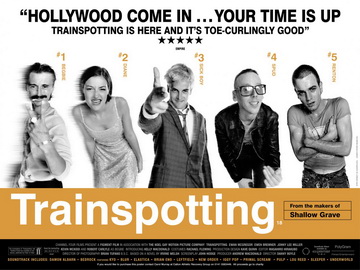
5. Trainspotting
(1996)
You probably don’t plan to take up heroin and let your baby
die of neglect, but might as well not be exposed to the vision of the
bloated baby corpse that skinny Ewan McGregor hallucinates is crawling on the ceiling when he’s
detoxing.
6. We Need to Talk
about Kevin (2011)
Do you ever worry that, instead of being a better version of
you or Michael Phelps, your kid will be a rapist or murderer or libertarian?
Well, here’s a movie that will make you worry that you’ll never bond with your
child and he’ll become a soulless human who carriers out a Columbine-like
massacre. I’ve never seen this, and I probably never will. The book plunged my
partner into such a funk that we now look back on the few weeks it took him to
finish it as one of the worst rough patches in our relationship.
7. Game of Thrones
season three (2013)
It’s better than most movies, OK? You know I’m right. But
please, don’t endure Joffrey’s deeper explorations of moral depravity and then
get to the episode with the Red Wedding. You just really aren’t in the frame of
mind to watch a pregnant woman be fatally, repeatedly stabbed in the belly. Or
actually, there’s a bad birth thing in the first season too. Maybe don’t start
watching this show right now. You might end up with a baby named Tyrion or Khaleesi.
I hope, for your sake, that you took my word on it and just
glanced at the titles here. Now mamas, go wash your brain out with Singin’ in the Rain and Pitch Perfect.
Another entry in the
series where I finally
watch the movies whose trailers I’ve seen a million times on VHS tapes that were played on a constant loop throughout adolescence. So far, the coming attractions are universally terrible.
Many of us grew up loving and defining our high school
experiences through John Hughes films. I still have a hard time rectifying my
deeply entrenched nostalgia for the movies that kept me company for untold
hours in adolescence with their often troubling themes: the fact that Sixteen Candles makes light of what is
objectively a date rape or that The
Breakfast Club features some graphic sexual harassment, among other issues. But seeing his 1988 film She's Having a Baby as an adult, there's no internal conflict about identifying exactly what is so absurd and awful about this movie.
Hughes films, many of them rom-coms, tended to end the story right about the
time a couple got together. So She’s
Having a Baby, which came out a few years after his Brat Pack stride, is the logical next step in these characters’ lives. It starts with high
school sweethearts’ wedding day and the mundane horror (only experienced by
men, apparently) of settling down into a career and married life after the
excitement of courtship is over.
This isn’t the She’s
Having a Baby trailer that I remember. I don’t know if it came before St. Elmo’s Fire or Ferris Bueller’s Day Off or something else. The trailer I remember featured
a semi-ominous strings score with quick cuts that made it seem like this
coming-of-age dramedy was a lot more serious than it turns out to be. Here’s
the only trailer I can find online—it’s a lot truer to the movie’s tone.
It’s a terrible movie for many reasons. These are just 10.
1. The protagonist is a milquetoast, mealy mouthed douche.
Kevin Bacon is in love with his wife but alternately consumed by either the
nightclub-hopping life he thinks singletons enjoy or a massive sense of
entitlement as a brilliant-yet-undiscovered writer (by day an ad copywriter).
His magnum opus ends up being the story told in this sappy, crappy movie.
2. Despite the fact that all of the main characters supposedly
grew up in Chicagoland, the wife, Elizabeth McGovern, is the only one who has
an accent. Those naaaaaaging A’s.
3. There’s so little development of why Bacon and McGovern even
like each other that we don’t particularly care if their relationship can last
despite temptation. See No. 6.
4. The depiction of marriage is insulting to anyone who’s ever
been in a relationship, but especially hetero women. This film adds to the
cultural narrative that marriage is something that women inherently want and
that makes men inherently miserable. When McGovern is given something to do
except stare blankly at something, she’s only concerned with nagging Bacon or
getting knocked up (and taking the pleasure out of sex). Bonus points for the
revelation that McGovern has never, ever, in their yearslong relationship,
initiated sex. Except when she went baby crazy.
5. Which brings us to the totally fucked-up theme of McGovern
trying to sneakily get pregnant. The trailer above frames this as part of "every married life"—when your lady tells you she’s gone off
the pill. Most women don’t just stop using contraceptives without telling their
partners. We all probably know a few women who would—but they are few. And
probably blood relatives.
6. At one point, the sleazy, bad-influence, bachelor best
friend (Alec Baldwin) comes on to McGovern and tells her she’s the only person
he’s ever loved. This follows longing glances in the one or two scenes he’s in
before this. It’s unbelievable that Baldwin pulls off tortured, unrequited love
in the face of McGovern’s just plain wooden performance. But he does! So it’s
pretty unsatisfying that she doesn’t go for it. That would have made exactly
one unexpected plot point in the whole movie.
7. Speaking of the totally dreamy young Baldwin, anyone who
rejects hetero, married, suburban bliss is either sinister or secretly
depressed, according to this film. Deep down, Baldwin just wants a nice wife.
And his one-time girlfriend, who isn’t interested in the suburbs or tradition,
is a condescending jerk who doesn’t even care that her mother is dead. And
according to Baldwin, she’s also a “slut.” That’s right, she dared to have sex
with him for fun.
8. The tone is all over the place. The scenes of Bacon
imagining assenting to suburban-consumer-hell vows during his wedding, seeing
his lawn-mowing neighbors break into dance to point out their
all-but-choreographed existence, and—a personal favorite—him burning the pages
of his book to keep his wife and would-be child warm, are jarring, unfunny, and
out of place. Especially when life-threatening stuff turns the movie to
tear-jerker territory. Father of the
Bride walked this line much more successfully a few years later.
9. There are weird cameos during the ending credits of Hughes-film
stars and other stars in character, including folks from Cheers and Star Trek: The
Next Generation. It’s the cherry on top of a random, inconsistent movie.
How does it work in the diegesis that Ferris Bueller and the guys from The Great Outdoors are suggesting names
for the baby? Maybe because most Hughes films are set around Chicago?
10. The film is called She’s
Having a Baby, but “she” isn’t even pregnant until well over an hour into
the 106-minute movie.
If you grew up with a VCR, you know practically by heart the
trailers that come before your favorite movies, even if you never got around to
seeing those particular “coming attractions.” But some of them probably
intrigued you—for me, these were mostly films that I wasn’t allowed to see. I snuck some of my most well-worn tapes into my collection under the
veil of independent or classic cinema that my parents either weren't familiar with or thought of as innocuous. But I always meant to get around to
seeing movies like Nightwatch (a
trailer before Trainspotting) and the
film that is the subject of this review, TheCotton Club (before The Untouchables) after I turned 17.
TheUntouchables being an obsession of mine
since I heard about its
homage to the “Odessa
Steps” scene, I’ve seen the trailer for TheCotton Club roughly eleventy billion times.
So it was quite a coup when I finally sat down to watch it on Netflix instant
this fall. And, cheesy and stilted as TheUntouchables often was (after all,
Kevin Costner and Sean Connery were the leading men), that film is the Citizen Kane of mobster movies compared
with the completely absurd, embarrassing TheCotton Club. This
movie is so bad on so many levels, it would take way too long to write a
properly scathing review. And frankly, it would almost be redundant. Res ipsa loquitur. So allow me to simply outline what I found compelling about the trailer and the top 10 reasons why
this (inexplicably Francis Ford Coppola-helmed) film failed in such an epic
fashion.
First, check out the trailer for yourself.
Aside from the damsel-in-distress themes that are so clear
in the trailer but didn’t bother my teenage self, there are still several
things the trailer has going for it. As evidenced by the many (more
successful) movies they've done together, Diane
Lane and Richard Gere have clear chemistry here.
That natural spark is completely doused in the actual film—basically every line
of dialogue that establishes the romantic connection between the two is in the
trailer. I, of course, assumed the love story would get fleshed out. In
addition to that tease, the costumes were awesome, young Lane seemed enigmatic
and magnetic, the set design was unique (I love the look of the
between-the-curtains backstage scene), the Harlem Renaissance is a compelling
and underrepresented (in film) period of cultural history, there was tap
dancing, and there was good music. It had the makings of a pretty good love
story set in the totally enthralling jazz age. To be fair, the musical and
dance numbers are terrific, but they just underscore how much the rest of the
film functions as shoddy filler.
So unfortunately, the finished piece was no crystal stair, if you
will. Here are just the top 10 reasons this movie is an insulting mess.
1. The main
love story is something you couldn’t possibly care less about. Like I
said, basically every scene that develops the story is in the trailer, and
then by the time they do get together, you’re still wondering why. They
are both kind of terrible.
2. The
fact that this film can’t decide whether it’s an ensemble piece or not.
It’s not hurting for stars: In addition to Lane and Gere, Nicolas Cage and
Laurence Fishburne appear in minor roles alongside several other folks
you’d probably recognize. But the way that The Cotton Club illogically
alternates among focusing on Gere’s cornet player/inadvertent actor, the
bad guy mobster, Cage’s wannabe mobster, Gere’s tap dancing neighbor, and the bromance between the not-as-bad gangster and
his second-in-command is not only dizzying but also shallow enough that we
don’t end up caring about what happens to any of the bunch.
3. Lines
like this (said from not-as-bad mobster to bad mobster and the other
baddie he’s quarreling with—with a zoom in on the speaker for gravitas): “In
the next room, gentlemen, is the best food, drink, and pussy available at
any price in New York. I suggest you take a sample of these things and
remember that this is why we work so hard.”
4. Lines
like this, which are apparently supposed to convey a mysterious bad guy’s
inexpressible evilness (over ominous music):
Gere's character: So, what do they call you?
Baddie: Nobody calls me nothing.
G: Not even your mother?
B: I didn't have a mother. They found me in a garbage pail.
5. Scenes
like the one where slapping becomes a dance move. In one of their more
disturbing exchanges, Gere and Lane’s mutual frustration (and Gere’s
possessiveness) culminates while they’re dancing. She slaps him, and he
slaps her back. The other folks on the dance floor are so amused that they
start emulating the incident as a dance move, thereby initiating a totally
absurd tonal shift in the scene while delegitimizing a clear instance of
possessive intimate partner violence.
6. The
fact that the film taught me yet another word for whore: moll. So happy to
have yet another sexually charged word to insult women.
7. The
completely unintimidating (and poorly dubbed?), mealy mouthed voice of the
main bad guy mobster. I can’t find any evidence of this on the Internet,
but the voice is so odd and mismatched to the actor and his apparent mouth
movements that it seems impossible to me that they didn’t dub in another
man’s voice in post-production—and change some of the lines to
boot.
8. That
they gave a really awesome tap dancer but terrible actor, Gregory Hines, a
dramatic role and yet another underdeveloped love story. Honestly, I’d
much rather see a fully explored version of this love story—between a
biracial singer-dancer who is passing as white and a black tap dancer—but
their story is left as shallow as Gere and Lane’s. Also, Lane may have
been the one who won
a Razzie for her performance in this film, but Hines is about the worst
actor I’ve ever seen in a widely released motion picture.
9. The
thrown-in themes addressing racial inequality. There could have been a lot
to say about white audiences’ consumption of (and simultaneous taming of)
black culture, but the TheCotton Club stops at remarking upon
the fact that black folks can perform at but not sit in the audience of
the club—at least until the end of the film—and that it’s wrongheaded to
take up arms to defend their spaces from white terrorism.
10. Lines
like this, from the little-seen Laurence Fishburne gangster: “When you get
Owney Madden on your ass, you truly have somebody on your ass.”
I could go on, but there are so many good movies out there. Let's spend our time seeking them out instead of kicking this dead horse. Surely the old VHS trailers won't lead me so astray next time.
Don’t let the Darko Entertainment logo fool you if you ever
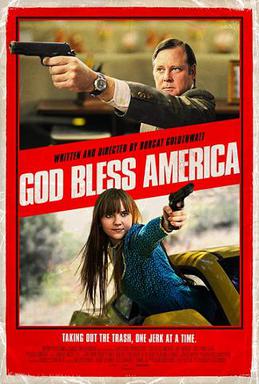
have the misfortune of seeing God Bless America. If you’re
a wannabe film buff ages 24–35, Donnie Darko is probably
your favorite movie. And though its status as a cult classic forced the film
into the uncanny valley
of popularity, at which point it becomes too popular to be cool, you can’t be
blamed for digging Darko or for
making the mistake of assuming that seeing a Frank the Bunny logo in
the opening credits of a film signals an auspicious start.
If God Bless America
is any indication, the Darko Entertainment logo might as well include a tagline
that warns, “Facepalm all ye who enter here.”
A miserable, 105-minute harangue about the evils of media,
reality TV, celebrity culture, and—wait for it—rudeness, God Bless America follows Frank, a disillusioned insomniac who gets
fed up with American culture and his annoying peers and goes on a killing
spree. You can’t miss the takeaway message in God Bless America, because Frank’s countless soliloquies about the
shallowness and inconsideration of Americans and media are about as subtle as
an icepick in the eye. Obviously, we all hate noisy neighbors, teenagers who
talk through movies, and the abusive voyeurism of reality TV. But this film is
so heavy-handed and obnoxious about teaching these lessons that Frank ends up
coming across more like a cantankerous grump who doesn’t understand the noisy
music and tweets that those youngns are always talking about these days than a
cultural-war hero.
God Bless America
is a pathetic attempt at being both Natural
Born Killers and Network. But
unlike the Oliver Stone and Sidney Lumet films that God Bless America wants so desperately to be, the Bobcat Goldthwait-directed
movie’s distain for salacious media isn’t punctured by any thoughtfulness,
theoretical insight, or any gesture toward subtlety.
The film starts with an admittedly funny montage of faux
reality shows that Frank watches late at night when he can’t sleep. These scenes
are the only few minutes of the film that are worth watching. Because even
though the shows-within-a-movie perpetuate the idea that women are catty,
fame-hungry bitches who can’t get along with each other, one scene includes a
catfight in which one woman takes out her tampon and throws it at another woman
for shitting in the first woman’s food. In another redeeming daydream sequence,
Frank skeet shoots a baby.
After being diagnosed with an apparently fatal tumor and
being fired from his job, Frank starts acting out these murderous fantasies. He
starts by hunting down a spoiled reality TV star and ends by targeting the
judges from an American Idol-type
show. So obviously the film is trying to convince us of the evils of media. But
this message gets mixed up when Frank eventually expands his targets to
basically anyone who is rude or who ends up on the wrong side of his pet
peeves. This message is further blurred when we see that Frank clearly desires
media coverage of his antics and when he takes a break from killing to go to a
movie theater to watch a documentary on the Mai Lai Massacre. During
the movie, Frank himself massacres some teenagers who were talking loudly.
We’re supposed to be on Frank’s side because he’s punishing the obnoxious
people that we’re powerless to stop in public. But in the logic of the diegesis,
he’s watching (and apparently appreciating) a film that is deeply critical of
senseless, mass killings.
These muddled moments speak to the larger problem in God Bless America. For a film that tries
so hard (like, Waylon Smithers
hard) to not only make a profound statement about culture but also to
symbolically work against it through Frank’s cathartic killings, the film ends
up reinforcing the same stereotypes and values that it explicitly positions
itself against, especially misogyny.
In Frank’s first big soliloquy—there are probably a baker’s
dozen throughout the film—he chastises his co-worker for being a fan of a
“shock jock” who is clearly modeled after Howard Stern. When explaining his
aversion to the radio personality, Frank says that he doesn’t tune in to the
show because he doesn’t hate people who have vaginas. So he’s aligning himself
with feminists who view Stern and his ilk as some of the most loathsome misogynists.
At this point, the audience could rally behind Frank. He’s
on the right side of a good cause. After all, media objectification and hatred
of women is a well-documented social ill. But Frank’s passion about this
particular cause is puzzling since the film goes on to villainize, violently
punish, or sexualize every woman Frank comes across in his personal life and on
TV.
First, there’s the woman secretary who doesn’t share Frank’s
affection. She actually sets Frank’s rage in motion in a scenario that
completely dismisses and delegitimizes the problem of sexual harassment in the
workplace. We’re supposed to side with Frank when he gets fired for looking up
the secretary’s home address—work files—to send her flowers. While that’s
probably not a fireable offense, the film treats the secretary’s anxiety over
Frank’s gesture as reactionary, politically correct, and ungrateful. But unless
you think that the long-standing, all-too-real problem of men sexually
harassing women at work just boils down to bitches not knowing how to take a
compliment, you could see the situation for what it really was. Frank was a
creepy flirt who mistook the secretary’s graciousness for romantic interest.
Given his propensity to go on a killing spree, the secretary probably sensed
that he was a little off. Imagine if, instead of sticking to friendly greetings
and book swaps, your off-kilter colleague looked up where you live in files that
are supposed to be confidential to do something that leaped over several levels
of appropriate acquaintance behavior. It would freak you out, too.
There’s also his ex-wife, who treats Frank callously when it
comes to custody issues with their daughter, who is just as much a spoiled,
horrible brat as the My Super Sweet 16-ish
reality star who ends up being Frank’s first victim. And, of course, how could
we forget his Lolita-ized sidekick.
Roxy the sidekick is played with about as much panache as
you might expect from a
former Disney star trying to build indie cred. She seems to revel in her pseudo
badassness when she delivers such gratuitous and ineffectual lines as “You look
like fuck pie, Frank.” And her contributions to Frank’s holy war are mostly to
suggest much more shallow targets (people who give high-fives or who misuse “literally”)
than Frank’s more seemingly righteous ones (a Glenn Beck-type pundit and the
Westboro Baptist Church congregation). She also proves that women are liars
when we find out that she’s not all she seems, and she helps bolster Frank’s uprightness
by repeatedly and unsuccessfully trying to seduce him.
Really, everything above is only the tip of the iceberg of
suck. There’s the crappy production, the incongruous music choices, the bizarre
aesthetic tangents, and one insanely, unnecessarily long gun-buying scene that seems
to only exist because the guy playing the gun dealer is someone important’s
BFF. This is an unfunny, politically limp movie that is trying its damndest to
be edgy and important. But ultimately, it’s a very familiar message: An ineffectual
white dude overcomes the bitches in his life and acquires phallic power to
claim the respect he believes he’s entitled to.
Bechdel
Test: Probably fail. I hate this movie way too much to go back and check.

 5. Trainspotting
(1996)
5. Trainspotting
(1996)